Mini Split Installation in Bowling Green, OH
A new system here will heat from October through May and cool from June through August every year. Tell us about the house, and a licensed contractor who covers Wood County will get in touch.
Tell us about the job
It takes about a minute.
What Bowling Green winters and summers ask of a mini-split
Your mini-split will run 11 months out of the year here. Wood County needs heat from October through May and cooling from June through August, so there is almost no time when the system sits idle. On winter nights averaging 22°F, a heat pump has to keep pulling warmth from air that cold, night after night, for 8 straight months. Summer afternoons average 83°F, so the cooling side gets real work too, just over a shorter stretch, 3 months instead of 8.
A new unit has to meet the federal minimum for a split-system heat pump, 14.3 SEER2 for cooling and 7.5 HSPF2 for heating. That minimum applies whether the mini-split is heating and cooling a whole house or just one room added onto a home that heats the rest of the way on gas.
- 8 months
- October through May, your system heats
- 3 months
- June through August, it cools
- 22°F
- the average winter night it heats against
- 83°F
- the average summer afternoon it cools against
NOAA nClimDiv, 1991–2020 normals
In Ohio, HVAC licensing for homes is left to the counties.
Wood County sets its own rule for who can do this work, since Ohio leaves HVAC licensing to the counties rather than handling it at the state level. That means there's no state record of the contractor's testing or standing, and what's required instead depends on the county's own system. Ohio does define a home contractor as one carrying at least $250,000 in liability insurance, but that's a definition of the term, not a license anyone has to earn.
For a mini-split installation, the protection here comes from the permit process rather than a license. Most cities and counties require a permit from the local building office for this kind of installation, along with an inspection once the work is finished, and that inspection is what checks the job was done right.
Source: Ohio Legislative Service Commission
- Is a mini split worth it?
- For the right room or house, yes. A mini split heats and cools without ducts, so it works well for additions, garages, or older homes where running ductwork is not practical. Down to 22 degrees on a cold night, a good cold-climate model still puts out heat, which matters here since Bowling Green needs heat from October through May. A contractor can look at your house and tell you whether it's the better fit over what you have now.
- How many rooms can a mini split cover?
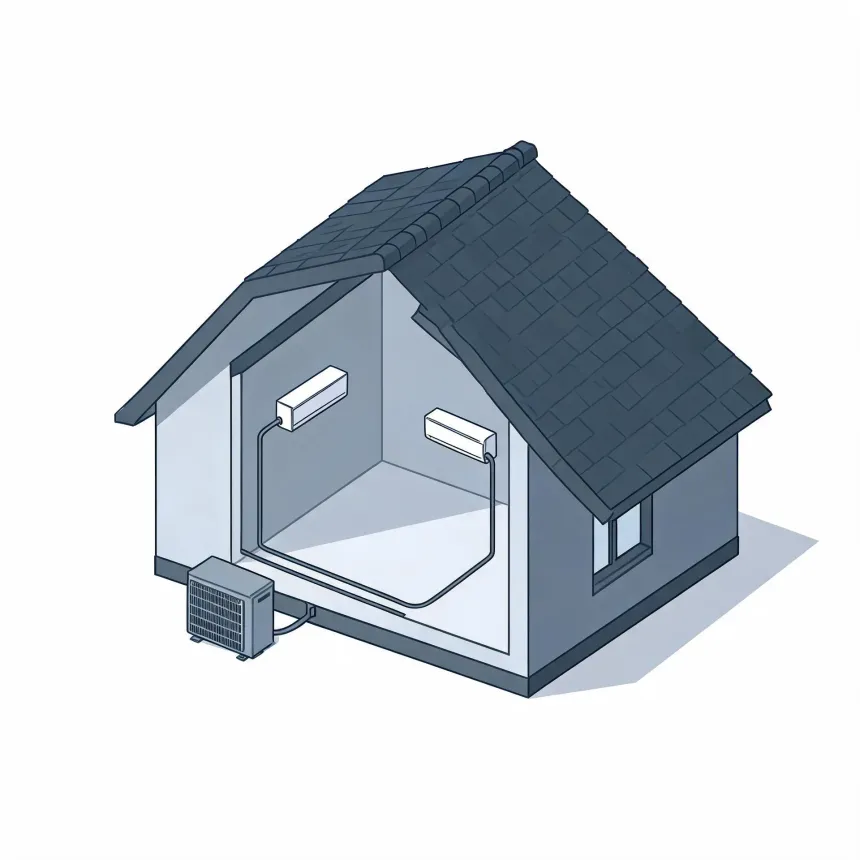
- A single indoor head is built for one room or one open area, but multi-zone systems run up to eight indoor heads off one outdoor unit. Each head is sized to the room it serves, so a bedroom and a living room would likely need different capacities. The number of rooms you can cover comes down to how many zones the outdoor unit supports and how much heating and cooling load each room has.
- Can a mini split heat a whole house?
- It can, if enough zones are installed to cover every room and the outdoor unit is sized for the whole house's heat loss. That's a bigger job than a single room installation and takes real load calculations for a place with winter lows around 22 degrees. A contractor can work out whether that approach makes sense for your house or whether pairing zones with your existing heat makes more sense.