
HVAC Repair in Springfield, OH
Homes here need heat from October through May and cooling from June through August. If your system quits, tell us what it's doing and a licensed contractor who covers Clark County will get in touch.
Tell us about the job
It takes about a minute.

Eleven months of work for one system
Clark County only gives your furnace and AC a few weeks off. Heat runs October through May, and cooling picks up right after for June through August. That leaves the system idle maybe a month out of the year, and most of that time it is holding steady against a 23°F night or an 83°F afternoon, not easing into either one.
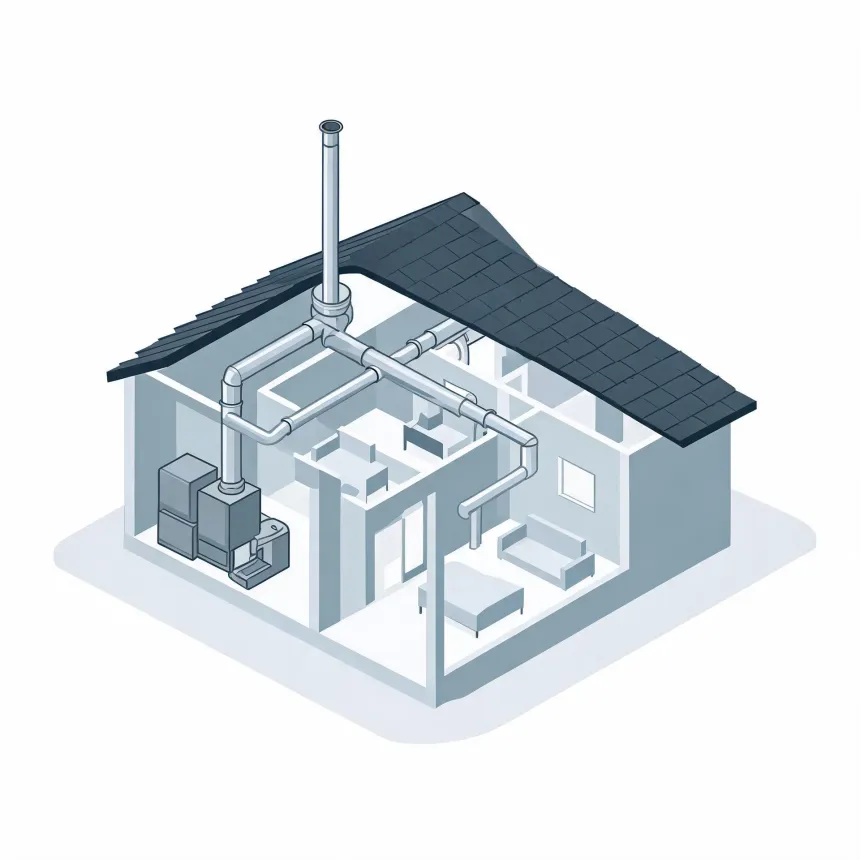
That kind of swing is hard on parts. The furnace cycles on and off all winter to keep up with those cold nights, and each start puts wear on the igniter. Most homes here heat with gas, so when the igniter goes, the burner will not light and the house goes cold. Summer runs the other way. The compressor works longest on the hottest afternoons, and that is when a weak capacitor or a low charge shows up as warm air from the vents. On top of that, Clark County sees its share of winter storms and wind, and a power blink during either season can knock the whole system offline until it is reset.
- 8 months
- October through May, your system heats
- 3 months
- June through August, it cools
- 23°F
- the average winter night it heats against
- 83°F
- the average summer afternoon it cools against
NOAA nClimDiv, 1991–2020 normals
A new furnace and air conditioner would cut about $170 a year off heating and cooling for a typical Clark County home.
Estimates for a typical Clark County home, compared with an older unit built to the previous federal minimum, from EIA household energy data, Ohio fuel prices and NOAA climate normals. Your home will differ.
Repair makes sense when one part has failed.
Replacement makes sense when the furnace's heat exchanger is cracked, the air conditioner's compressor has failed, or repairs keep coming.
In Ohio, HVAC licensing for homes is left to the counties.
Whether Clark County requires an HVAC license, and what that license requires, is a county rule rather than a state one. Ohio itself keeps no state record of who is licensed to do this work. Ohio does define a home contractor as someone carrying at least $250,000 in liability insurance, but that is a definition written into state law, not a license anyone tested for.
For a heating and cooling repair, whatever accountability exists behind the work comes from Clark County, since Ohio has no state license standing behind it. Gas connections are the part of this kind of repair where a mistake matters most. Ohio's own answer stops at that insurance definition, so anything beyond it is a matter of what Clark County itself requires.
Source: Ohio Legislative Service Commission
- Why is my heat not working?
- Start with the thermostat and the power to the furnace before you assume the worst. Check that the thermostat is set to heat and a few degrees above room temperature, then check the breaker and the switch that looks like a light switch near the furnace, since that cuts power to it too. If the furnace runs on gas, look at the gas valve and make sure the pilot light is lit if it has one. Winter nights here drop to 23°F on average, so a furnace that will not start needs a contractor out soon rather than waiting it out.
- Why is my system running but not cooling the house?
- Check the air filter first. A filter clogged with dust blocks airflow across the indoor coil, and when air cannot move past it the coil can ice over, which makes the system run without cooling the house. Check the outdoor unit too, since leaves, grass clippings or anything else packed against the coil outside stops it from releasing heat the same way. If the filter is clean and the outdoor unit is clear, the problem is inside the system and a contractor will need to look at it.
- What can I check before calling for HVAC repair?
- Check the thermostat settings, the batteries in it if it uses any, and the breaker for the system before anything else. Check the air filter and replace it if it is gray or clogged, since restricted airflow causes problems on both the heating and cooling side. Look at the vents around the house and make sure furniture or rugs are not blocking them. If the outdoor unit is covered in leaves or debris, clear the area around it. None of this fixes an electrical or mechanical failure inside the system, but it rules out the simple causes before a contractor comes out.