Mini Split Installation in Springfield, OH
A new system here will heat from October through May and cool from June through August every year. Tell us about the house, and a licensed contractor who covers Clark County will get in touch.
Tell us about the job
It takes about a minute.
What a mini-split here has to handle
Winter nights in Clark County average 23°F. Homes here need heat from October through May, then cooling through the summer months of June through August. That leaves only one month of the year asking nothing of the system.
A new mini-split has to meet the federal minimum for split-system heat pumps, 14.3 SEER2 for cooling and 7.5 HSPF2 for heating. That minimum applies whether the system is ducted or ductless. With 11 months of run time, sizing the unit for what winter and summer here actually ask of it matters as much as the rating on the label.
- 8 months
- October through May, your system heats
- 3 months
- June through August, it cools
- 23°F
- the average winter night it heats against
- 83°F
- the average summer afternoon it cools against
NOAA nClimDiv, 1991–2020 normals
In Ohio, HVAC licensing for homes is left to the counties.
Clark County sets its own rule for who can do this work, since Ohio leaves HVAC licensing to the counties rather than testing and recording contractors at the state level. Ohio does define what a home contractor is, and that definition includes carrying at least $250,000 in liability insurance. That is not a license and nothing is tested against it. It just sets a floor for what counts as a legitimate home contractor in the state's eyes.
For a mini-split installation, the protection you have here is the permit process rather than a license number. Most cities and counties require a permit from the local building office for this kind of installation, with an inspection once the work is done. That inspection is what checks the work, including the electrical and refrigerant line connections, in place of a county license.
Source: Ohio Legislative Service Commission
- Is a mini split worth it?
- For the right room or house, yes. A mini split heats and cools without ducts, so you're not losing energy to air leaking out of duct joints in an attic or crawlspace. It's worth looking at closely if you're heating or cooling a space that has no ductwork now, like a converted garage or a room addition, or if one room in a ducted house never gets comfortable. Your winters here run cold enough that a contractor needs to check the unit's rating at low temperatures before you count on it as your only heat source.
- How many rooms can a mini split cover?
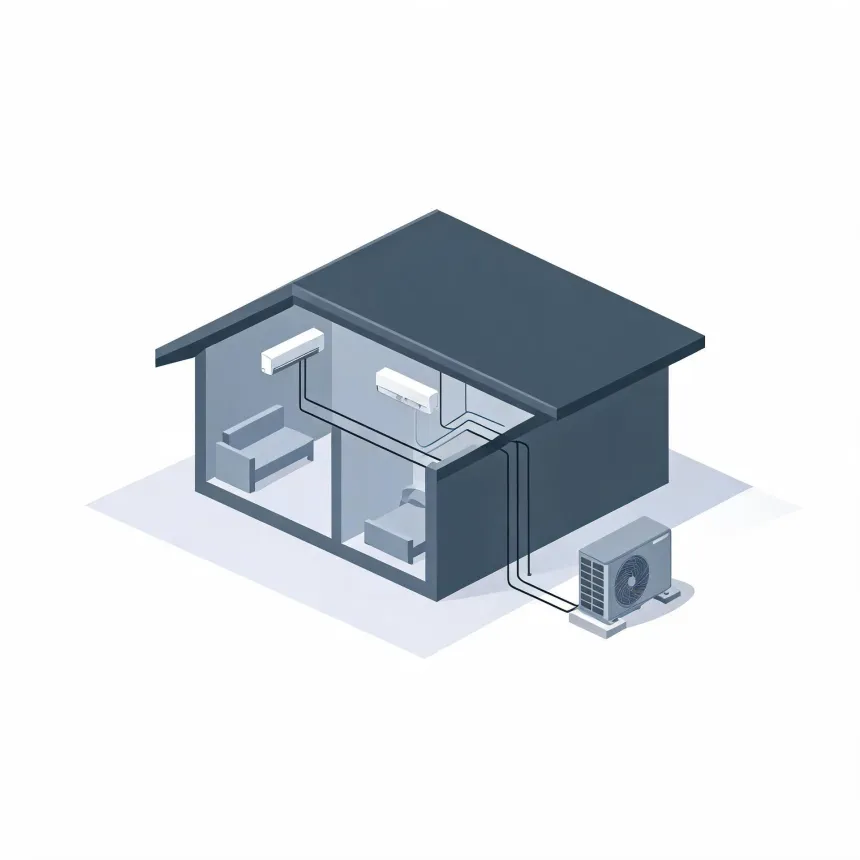
- One outdoor unit can run one indoor head or several, depending on the system. A single-zone system heats and cools one room or open area. A multi-zone system runs multiple indoor heads, sometimes up to eight, off one outdoor unit, with each head controlled on its own. How many rooms make sense on one system comes down to the size of each room and how far the indoor heads sit from the outdoor unit, so a contractor will need to look at your house to size it right.
- Can a mini split heat a whole house?
- It can, but it takes the right setup. A multi-zone mini split with an indoor head in each room or main area can heat an entire house without any ducts. Whether one will keep up on your coldest nights depends on the specific unit. Winter lows here average 23°F, and not every mini split holds its heating output at that temperature, so ask the contractor for the unit's rated capacity in cold weather before you count on it as your only heat.