Mini Split Installation in Hamilton, OH
A new system here will heat from October through April and cool from June through September every year. Tell us about the house, and a licensed contractor who covers Butler County will get in touch.
Tell us about the job
It takes about a minute.
Eleven months of work for a mini-split in Hamilton
Winter nights here average 24°F, and summer afternoons average 85°F. Whatever mini-split goes in has to handle both ends of that, heating through the cold nights from October to April and cooling through the summer from June to September. Only one month goes by without either job.
Any new ductless heat pump built now has to meet 14.3 SEER2 for cooling and 7.5 HSPF2 for heating, the federal minimum for split-system heat pumps. That's the floor. In a climate that asks for heat seven months and cooling four, what matters more is sizing the unit to the house and the job it has to do the other eleven months of the year.
- 7 months
- October through April, your system heats
- 4 months
- June through September, it cools
- 24°F
- the average winter night it heats against
- 85°F
- the average summer afternoon it cools against
NOAA nClimDiv, 1991–2020 normals
In Ohio, HVAC licensing for homes is left to the counties.
Butler County sets its own rule for who can do this work, since Ohio leaves HVAC licensing to the counties rather than running a state program. That means there's no state license or state record to check here. Ohio does define a home contractor as someone carrying at least $250,000 in liability insurance, but that's a definition of the term, not a license anyone has to earn.
For a mini-split installation, the protection that reaches into this job is the permit and inspection process most cities and counties require. The local building office issues the permit before the work starts, and an inspection after it's done is what checks that the installation was done right. That permit and inspection stand in for the license this state doesn't issue.
Source: Ohio Legislative Service Commission
- Is a mini split worth it?
- For most homes it comes down to what you're heating or cooling and how often you use that space. A mini split handles a room or an addition without ductwork, and it runs on demand instead of heating or cooling the whole house to fix one space. Hamilton needs heat seven months a year and cooling four, so a unit here earns its keep most of the year. Whether it makes sense for your house depends on the layout and what you're trying to solve, and a contractor can walk through that with you.
- How many rooms can a mini split cover?
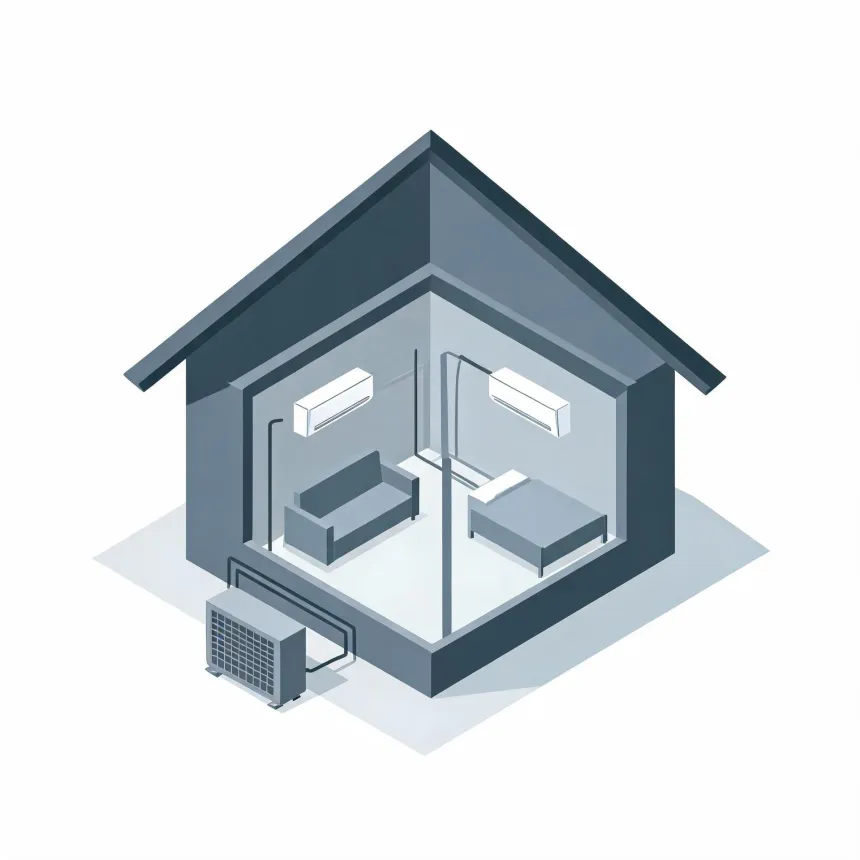
- A single indoor head is built for one room or one open area. If you need to cover more than that, a multi-zone system lets one outdoor unit run several indoor heads, each with its own thermostat, so you can heat or cool a few rooms independently. How many heads an outdoor unit can support depends on its size, and a contractor can size that to your house.
- Can a mini split heat a whole house?
- It can, if it's designed for that from the start. A multi-zone system with enough indoor heads can cover every room, and mini split heat pumps are built to keep working in cold weather. Hamilton winter nights average 24°F, so the system has to be sized for that low, not just for a mild day. Getting that sizing right for your house is a job for a contractor who can look at the layout room by room.