Mini Split Installation in Dayton, OH
A new system here will heat from October through May and cool from June through September every year. Tell us about the house, and a licensed contractor who covers Montgomery County will get in touch.
Tell us about the job
It takes about a minute.
What Dayton winters and summers ask of a mini-split
Your mini-split works both ends of the year here. Winter nights average 24°F, and heat runs October through May, eight months straight. Summer afternoons average 84°F, so the same unit switches over and cools June through September. Homes here need it one way or the other all year.
A unit built for that kind of duty has to meet the federal minimum for a split-system heat pump. If it was manufactured on or after January 1, 2023, that means 14.3 SEER2 for cooling and 7.5 HSPF2 for heating. In a place asking for heat eight months of the year, the heating side of that rating matters as much as the cooling side.
- 8 months
- October through May, your system heats
- 4 months
- June through September, it cools
- 24°F
- the average winter night it heats against
- 84°F
- the average summer afternoon it cools against
NOAA nClimDiv, 1991–2020 normals
In Ohio, HVAC licensing for homes is left to the counties.
In Montgomery County, whether a contractor needs a license depends on the local rules where the house sits, since Ohio leaves that decision to counties. Ohio does define what a home contractor is, and that definition includes carrying at least $250,000 in liability insurance, but that is not a license and nobody tests for it.
For a mini-split installation, the protection here comes from the permit process rather than a state license. Most cities and counties require a permit from the local building office for this kind of installation, along with an inspection once the work is done. That inspection is what checks the job was done right.
Source: Ohio Legislative Service Commission
- Is a mini split worth it?
- For the right room or house, yes. A mini split heats and cools without ducts, so you are not losing energy to leaky ductwork, and each zone has its own thermostat so you are not heating or cooling rooms nobody is using. Here, where heat is needed October through May and cooling June through September, a system that handles both jobs well earns its keep almost year round. Cold-climate models are built to keep working at 24°F and below, so winter nights in this area are not a problem for the right unit.
- How many rooms can a mini split cover?
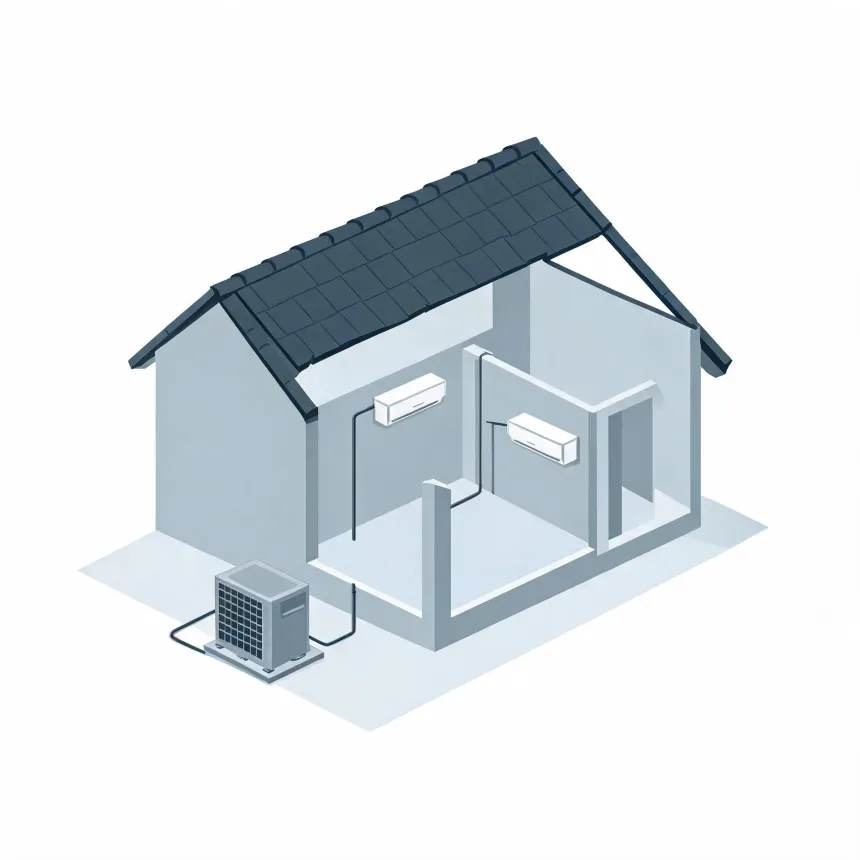
- A single outdoor unit can run one indoor head or several, depending on the system. Single-zone systems cover one room. Multi-zone systems can run up to eight indoor heads off one outdoor condenser, each one set to its own temperature. A contractor will size the system to the square footage and layout of the house, since how many rooms one outdoor unit can carry depends on the total heating and cooling load, not just a room count.
- Can a mini split heat a whole house?
- Yes, with enough indoor heads placed and sized for the whole house, not just one or two rooms. This matters more here than in milder places, since homes in this area need heat for eight months of the year, October through May, and winter lows average 24°F. A cold-climate mini split is built to keep producing heat at those temperatures, but the system has to be sized for the whole house from the start. A contractor can work out the room-by-room heat loss and lay out the heads to cover it.