Side profile of a bearded man wearing a faded dark blue baseball cap and a matching dark T-shirt against a plain light gray background.

Mold in air ducts in Cincinnati, OH

Duct and vent cleaningDucts or ventsHamilton County, OH
Step 1 of 2

What ZIP code is the job in?

Can mold actually grow inside my air ducts?

Someone in Hamilton County notices a musty smell when the furnace or AC kicks on, or they saw dark spots around a vent cover, and they want to know if that is actually mold or just dust and dirt built up over time. They are trying to figure out if this is something worth paying attention to before it spreads through the house.

Yes, mold can grow inside your air ducts

Mold needs moisture and something to feed on, and ductwork can have both. Condensation collects on the duct walls when humid air meets cool metal, especially on the AC side of the system during the muggy months here. Dust sitting in the ducts gives mold something to grow on once that moisture is there. Once it takes hold, running the furnace or the AC pushes the air, and whatever is growing in that air, through every room the ducts reach. A musty smell when the system turns on, or dark spots around a vent, are both signs worth checking rather than ignoring.

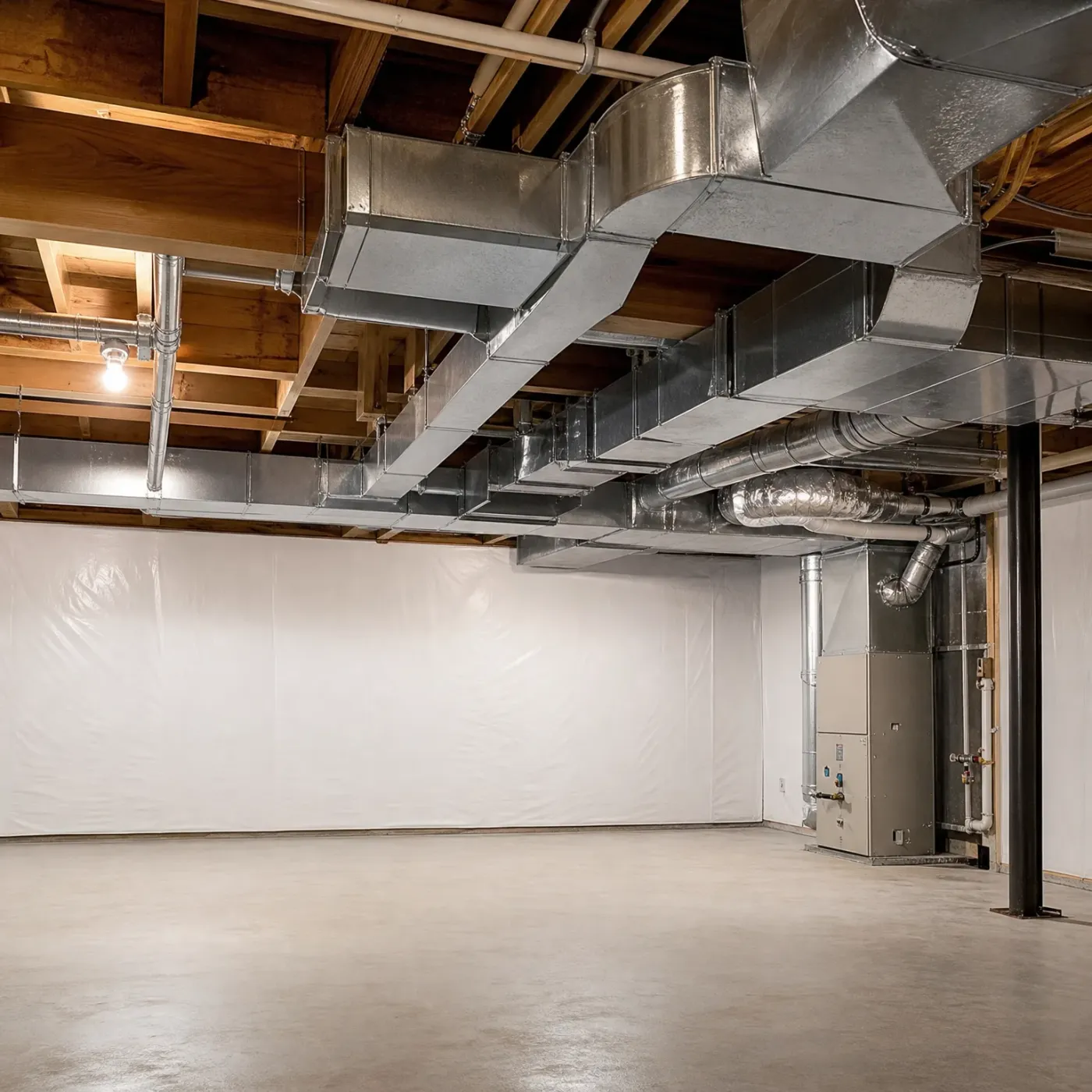
Empty basement with bare concrete floor, white plastic sheeting over one wall, exposed wood joists, galvanized sheet-metal ductwork and pipes overhead, and a furnace unit with a steel support column at right.

Clean duct, dry basement

This is what galvanized ductwork should look like. Metal is dry, joints are tight, and the vapor barrier on the walls is keeping ground moisture out of the basement air. Dry ducts don't grow mold. Mold needs standing moisture or a steady damp surface to take hold on.
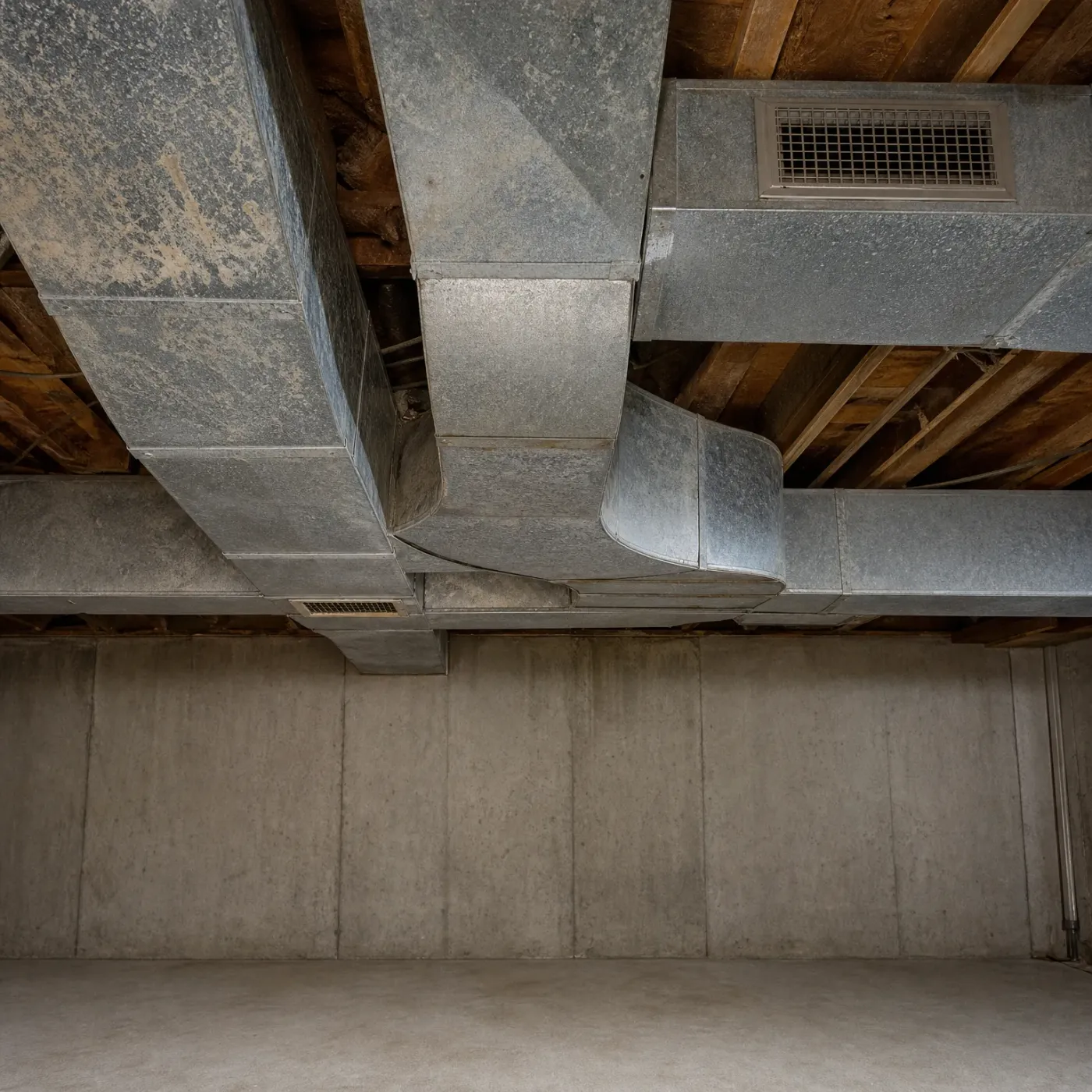

Galvanized sheet metal HVAC ducts with vent grilles run along a wooden floor joist ceiling above bare concrete walls and floor in an unfinished basement.

Ducts with nothing to stop the damp

Here the ducts run through the same kind of basement, but nothing lines the concrete walls. Bare concrete sweats in Cincinnati's muggy summers, and that moisture settles on the metal above it. Sheet metal that stays damp against humid basement air is exactly where mold gets started.

Why would my ducts in Hamilton County even grow mold?

  • Half the homes here were built by 1963

    Half the homes in Hamilton County were built in 1963 or earlier, per Census data. Older ductwork and basements are more likely to have seams, gaps, or damp crawlspaces that let moisture into the system.

  • Heat runs October through April

    Heat runs here from October through April, about seven months a year. That long stretch means warm duct air meets cold basement surfaces for most of the year, and that's where condensation starts.

  • Cooling runs June through September

    Cooling runs June through September. Those are the months ducts carry the coldest air against the warmest, most humid surroundings, which is exactly when condensation inside the system is most likely.

ACS 2020-2024 · NOAA nClimDiv 1991-2020

Galvanized sheet metal HVAC ductwork and round pipes running along an exposed wood-joist basement ceiling beside a plain white wall.

What mold needs to take hold

Mold doesn't grow on dry metal no matter how dusty it is. It needs moisture sitting somewhere in the system, usually from a duct that sweats in humid weather or a drain pan that isn't draining right. Cincinnati summers push a lot of moisture into the air, and if your ducts run through a damp basement or crawlspace, that moisture has somewhere to land. Dust alone just sits there. Mold needs water to start.

Galvanized sheet metal HVAC ducts and round pipes installed among wooden joists on a ceiling, beside a large blank white wall.

Why a musty smell travels

Your duct system pulls air from every room back to the furnace or air handler and pushes it back out again. If mold is growing somewhere in that loop, the smell doesn't stay put. It rides the airflow to every vent the system feeds, which is why you might notice it in the bedroom even though the moisture problem is in a basement return duct nowhere near there. A smell that shows up at multiple vents points to the ductwork itself, not a single damp corner of the house.

Does my house smell different when the air is running

You might catch it most when the AC first kicks on in July, a damp, earthy smell that fades after a few minutes, or you might notice it's always there near one vent and not the others. Some people see it before they smell it: a gray or black haze on the inside lip of a vent cover, or a ring of dark spots on the ceiling where a duct runs above it. Clothes and furniture near that vent can start to pick up the smell too. Left alone, it doesn't stay confined to the duct. It spreads through whatever air that system pushes, which in most houses is every room on the system.

A woman in a cream cowl-neck sweater stands in a lamp-lit room looking out a window at a snow-covered yard with shrubs and bare trees at dusk.
A woman in a gray turtleneck sweater stands near a large window in a lamp-lit living room, looking out at falling snow and snow-covered conifers.
A woman in a chunky knit sweater stands by a large window looking out at snow-covered ground, with a dimly lit living room containing a gray sofa, framed artwork, shelves and table lamps behind her.
A woman in a gray turtleneck sweater stands in a dimly lit living room with a lamp and bookshelves, looking out a multi-pane window at falling snow.

Find a duct system cleaning pro in Hamilton County

You've noticed the smell, or the dark spots around the vent, and now you're trying to figure out what to do about it. Checking it yourself usually means pulling a vent cover and looking at a few inches of duct with a flashlight, which doesn't tell you much about what's happening ten feet down the line or in the basement runs you can't reach. A contractor who does duct work in Hamilton County homes can actually get a camera or a hand into the system and tell you whether what you're smelling is mold growing on damp metal or just dust. Finding someone who does this, calling a few numbers, explaining the musty smell and the spots around the vent more than once, then waiting on quotes takes time you'd rather not spend while that smell keeps coming through the vents every time the furnace or AC runs. Submitting the request here skips the searching and the repeat explaining, and puts your situation in front of someone who can actually look at your ducts.

How mold actually spreads through ductwork

  • Mold growing inside a duct needs a food source, and the dust and skin cells that settle on duct walls give it one.
  • Spores travel on air movement alone, so a colony near the furnace can seed a vent in a bedroom on the other side of the house.
  • A duct lined with insulation on the inside, common in older flex runs, holds moisture longer than bare sheet metal and is harder to dry out.
  • Mold inside the return side of the system gets pulled through the blower and filter before it ever reaches the supply vents.
  • A coil that stays wet between cooling cycles keeps the air right behind it damp enough for mold to hold on even after the AC shuts off.
  • Spores that settle and dry out don't die, they just wait for moisture to come back.

Mold doesn't need standing water to get established in a duct system. It needs something to eat and somewhere damp enough to hold on, and ductwork gives it both. Dust and skin cells settle on duct walls the same way they settle on furniture, and that layer is enough food for a colony to start. Once it's there, it doesn't stay put. Spores don't need running water or a direct path, they move on whatever air the blower is already pushing, so a patch growing near the furnace can reach a bedroom vent on the far side of the house within days.

Where the duct is built matters too. A lot of older homes in Hamilton County run flex duct with insulation lining the inside of the tube rather than wrapped around the outside. That inner lining holds moisture against the surface longer than bare metal would, which gives mold more time to take hold before anything dries out.

The return side is often the part people forget to check. Air pulled back toward the furnace passes through the return duct and the filter before it circulates again, so anything growing there gets drawn through the system on every cycle, filter or no filter. And even after the AC shuts off, a coil that hasn't fully dried keeps the air around it damp enough for mold to survive, sometimes for days. Spores that dry out in between don't die. They sit still until moisture comes back.

Power here costs 16.82 cents per kilowatt-hour

At 16.82 cents a kilowatt-hour, running a fan or dehumidifier to dry out a damp basement adds up fast. It's cheaper to find where the moisture is getting into your ducts and stop it there than to keep fighting it with power.

EIA-861 2025

Mold in a duct system comes down to moisture finding a way in, whether that's a sweating supply line in August or a damp spot in the basement where the return sits. A musty smell when the furnace or AC kicks on, or dark spots around a vent cover, are worth paying attention to rather than wiping away and forgetting. Dry metal doesn't grow mold no matter how much dust has settled on it. Finding where the moisture is getting in, and getting the duct system properly cleaned, is the way to deal with it instead of guessing from a flashlight and a vent cover. A contractor who works on duct systems in Hamilton County can take a real look, tell you what's actually going on in yours, and get it cleaned out. That beats searching around for someone to call, explaining the smell and the spots over the phone, and sorting through quotes on your own.

A bearded man in a plaid flannel shirt stands indoors looking out a condensation-covered window at a snowy landscape, with a speckled mug on the sill and kitchen shelves behind him.
A bearded man in a dark t-shirt sits on a light sofa, smiling and looking down toward a laptop screen visible at the bottom edge of the frame, with a blurred living space behind him.

Get matched with a duct system pro in Hamilton County

A musty smell when the air kicks on and dark spots around a vent cover both point to moisture sitting somewhere in the duct system, and that's worth checking rather than ignoring. Finding where it's getting in takes someone who can get into the ductwork and the basement, not a flashlight through a vent. Instead of searching for a contractor, calling a few, and explaining the smell and the spots to each one, answer a few questions here and get matched with a contractor who handles duct cleaning in Hamilton County. They'll reach out to you directly.

Start one form

One form replaces the calls you'd make to find a duct system pro.

There's no charge for the request.